Product A/B Testing: The Complete Guide to Data-Driven Optimization for Better Conversions and User Experiences – Now Powered by AI
In today’s competitive digital landscape, guessing what works for your product or website is no longer enough. Product A/B testing (split testing or bucket testing) allows teams to compare two or more versions of a webpage, feature, or element to determine which performs better based on real user data.
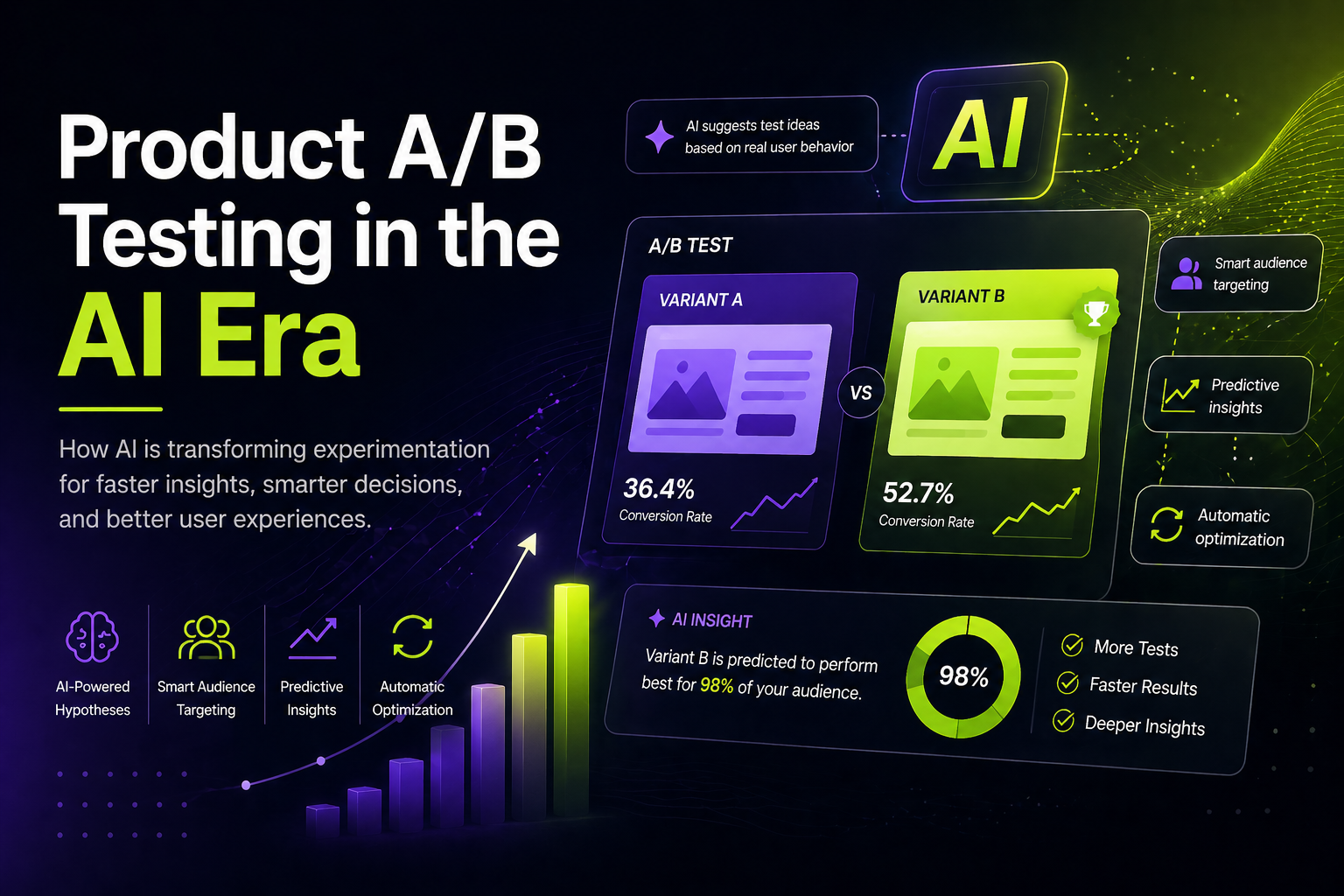
With the integration of AI in A/B testing, experimentation has evolved from slow, manual processes into faster, smarter, and more scalable programs. AI now assists across the entire testing lifecycle — from hypothesis generation and variant creation to real-time analysis, predictive insights, and automated personalization.
At Knix.agency, we help brands build high-velocity experimentation programs that combine rigorous A/B testing with cutting-edge AI capabilities to boost conversions, improve retention, and accelerate product development. This updated 2026 guide covers everything from initial setup to recommended tools, AI integration strategies, expert tips, and best practices.
What Is Product A/B Testing in the Age of AI?
Traditional A/B testing shows version A (control) to one group and version B (variant) to another, measuring differences in key metrics like conversion rate, click-through rate, or revenue per visitor.
AI-enhanced A/B testing goes further by leveraging machine learning, generative AI, and predictive analytics to:
- Automatically generate high-quality hypotheses and design variations
- Run multi-armed bandit tests that dynamically shift traffic to winners in real time
- Detect anomalies, segment results intelligently, and explain why a variant won
- Enable continuous optimization and hyper-personalization at scale
- Reduce required sample sizes and testing duration while maintaining statistical rigor
Modern experimentation now includes feature flags in SaaS products, mobile app flows, dynamic pricing, and AI-orchestrated experiences that adapt per user.
Why Integrate AI into Your Product A/B Testing Program?
AI delivers compounding advantages:
- Faster results — AI analyzes data in real time, predicts winners earlier, and automates analysis, shortening test cycles from weeks to days.
- Higher test velocity — Generative AI creates dozens of variants, copy, and designs quickly, allowing more experiments with fewer resources.
- Deeper insights — AI uncovers hidden patterns, segment-specific effects, and behavioral explanations that humans might miss.
- Reduced risk and bias — Anomaly detection, automated validity checks, and propensity modeling improve experiment reliability.
- Scalable personalization — Move beyond static A/B tests to AI-driven dynamic experiences that learn continuously.
- Better ROI — Teams run more impactful tests focused on high-leverage changes rather than minor tweaks.
Companies embracing AI-powered experimentation often achieve higher conversion lifts and build a true culture of continuous, evidence-based optimization.
Step-by-Step: Initial Setup for AI-Enhanced Product A/B Testing
- Define Clear Goals and Metrics Establish a primary success metric and guardrail metrics. AI tools can help simulate potential impact and prioritize metrics.
- Formulate Strong, Data-Backed Hypotheses Use AI assistants to analyze past experiments, session replays, heatmaps, and qualitative data to generate or refine hypotheses. Example prompt: “Analyze our checkout drop-off data and heatmaps to suggest 5 testable hypotheses for reducing friction.”
- Identify High-Impact Elements to Test AI can scan pages, review historical performance, and recommend elements with the highest potential uplift (headlines, CTAs, layouts, pricing structures).
- Audience Segmentation and Targeting Leverage AI for predictive segmentation and real-time behavioral targeting instead of simple random splits.
- Implement the Test (Client-Side or Server-Side) Many modern platforms offer AI-assisted visual editors or code generation for faster implementation.
- Determine Sample Size and Run the Test AI-powered statistical engines (Bayesian approaches) often deliver results with smaller samples or earlier peeks while controlling error rates.
- Monitor, Analyze, and Act Use AI for automated summaries, anomaly detection, segment deep-dives, and natural-language explanations of results. Implement winners and feed learnings back into the system for continuous improvement.
Recommended A/B Testing Tools with Strong AI Capabilities in 2026
How to Integrate AI Effectively: Tips and Tricks
- AI for Hypothesis Generation — Feed historical test results, user feedback, and behavioral data into generative AI to create diverse, prioritized hypotheses grounded in your own data.
- Variant Creation — Use AI to generate copy variations, image edits, layouts, or even full design mocks — dramatically increasing testing velocity.
- Real-Time Optimization — Switch to or combine with multi-armed bandit algorithms so AI automatically allocates more traffic to better-performing variants during the test.
- Automated Analysis — Leverage AI for instant result summaries, sentiment analysis on qualitative feedback, anomaly detection, and segment-specific insights.
- Predictive Insights — Use AI to forecast potential uplift before launching and simulate outcomes based on historical patterns.
- Combine with Qualitative Data — AI session replay analysis and automated friction detection help explain statistical wins or losses.
- Iterative Learning Loops — Feed every test outcome back into the AI system so future suggestions improve over time.
Best Practices for AI-Enhanced A/B Testing
Best Tools for A/B Testing in Elementor (2026)
- Maintain human oversight — AI is a powerful copilot, not a replacement for strategic thinking and business context.
- Always ground AI suggestions in your data and user research to avoid generic or hallucinated ideas.
- Combine frequentist and Bayesian statistics where available for robust decision-making.
- Monitor for new risks such as AI-induced bias in segmentation or over-reliance on short-term signals.
- Document AI-assisted decisions alongside traditional ones to build institutional knowledge.
- Focus on high-leverage tests (pricing, onboarding, checkout) rather than letting AI generate endless minor variations.
- Ensure privacy compliance (GDPR/CCPA) — especially with behavioral and predictive AI features.
- Build a feedback loop: Use winning (and losing) test learnings to continuously train and refine your AI experimentation models.
Common Pitfalls to Avoid:
- Treating AI-generated ideas as ready-to-launch without validation.
- Ending tests too early even when AI suggests a “winner.”
- Ignoring guardrail metrics — AI might optimize one KPI at the expense of long-term user satisfaction or churn.
Running too many concurrent AI-suggested tests without proper collision management.
Conclusion: Make AI-Powered Experimentation Your Competitive Advantage
Product A/B testing remains one of the most powerful methods for continuous improvement. By intelligently integrating AI, you can run more tests, get results faster, gain deeper insights, and deliver personalized experiences that truly resonate with users.
The future belongs to teams that treat experimentation as an always-on, intelligence-driven engine rather than isolated projects.
Ready to elevate your A/B testing program with AI in 2026? Contact Knix.agency today for a free experimentation + AI maturity assessment and build a tailored strategy that drives measurable, sustainable growth.